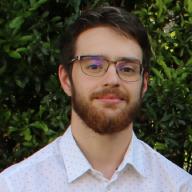
I was officially PhD student for 3,5 years1 from October,1 2021 to March 31 2025. I defended my thesis on March, 27th 2025. In the following, As I am about to start a postdoc, I take the opportunity to look back at my PhD experience, maybe reading this will help you decide to do a PhD, or help you if you already fell into the sweet honeypot.
Why I started a PhD#
Overall I think I decided to do a PhD for the following reasons:
- I liked the research experience I had during my year-long research internship at the Karlsruhe Institut für Technology (KIT) 2 , the constant tinkering and thinking to try to make things better (or just work at least).
- I think I got partially brain-washed by my professors at ENS Cachan, who were all doing research and telling us how great it was.
- There is the “engagement décennal” for paid student of ENS: Since the first day you are a student at ENS, you are committing to work for the French state for 10 years (including the years you spent as a student). Doing a PhD is a way to fullfill this commitment while doing something I like.
- I didn’t really know what I wanted to do after the master. Yes, I knew that I wanted to do something related to medical imaging, but the course of my life was not clear to me 3, so going for a PhD was a way to keep my options open, and buy some time…
Getting ready#
I got told several time that key aspect to consider a PhD is a three way match between you, your future advisor and the research topic. I decided to contact several professors of my master, and I got the opportunity to work with Philippe Ciuciu and Alexandre Vignaud, who were looking for a PhD student in the field of functional MRI reconstruction using Deep Learning. I had no experience in MRI, but I was eager to learn. We secured funding from ENS (via a special grant for students from ENS), and I started my PhD in October 2021.
However, I think the fit between the topic, the supervisors and the candidate is not all. I think it is also critical to get:
- A good research environment: Research happens in a team, not in full isolation. Landing somewhere with a fair share of PhD students who struggles, succeeds and have fun together is important. I also think that two supervisors are better than one, and it’s even better if they have already supervised PhD students together before. They can share the load, and you get two different point of views on your work.
- Stability at home: I am more and more convinced that having some stability and strong support and understanding from your friends and family is critical to succeed in a PhD4. I was lucky to have both, I found that the PhD is taking a very large part of your life and energy
- A hobby: Doing something else than the PhD all-day long is of utmost importance. Some people do sports (I only started back in my second year, and I should have started earlier), play music, or just hang out. If you don’t have anything else than the PhD, it fails to be a life.
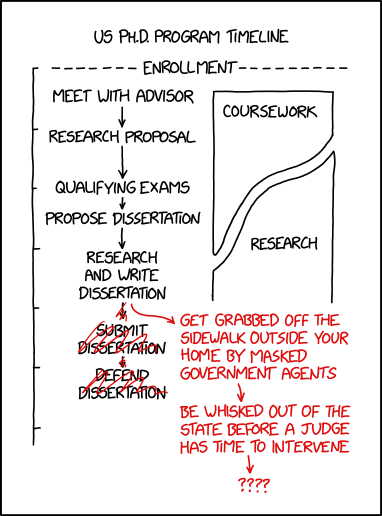
Untold secrets of the PhD#
As I started my PhD I had not much ideas of what to expect, I knew I would have to read a lot of papers, and maybe have the opportunity to write some, and at the end the dissertation. It was not clear to me what the day-to-day life would be.
Here are some of the never-told things I learned during my PhD:
You spend a lot of time in meetings: some are interesting, most are not, only a few are relevant to your topic. The thing is to manage a good balance between learning new things just out of curiosity, and staying focused on your topic (and fixing that damn bug in your code).
More often than you wish, you will have to present your work. Be it your half-baked figure shown over the screen or at a top-of-the-art conference, you will have to learn to present your work, and to take feedback. This is not always easy, but it is a skill that you will develop over time. Protip: Always have a few slides ready to present.
Communication is key: Any feedback from your supervisors, your colleagues, or even people outside your field is useful. You need to be able to explain what you are doing, and why it matters. This is not always easy, but it is a skill that you will develop over time (Also be ready to hear: “What is your PhD about ?” from anyone, and be ready to answer them so that they think they have understood it).
It barely works. You will spend a lot of time trying to make things work, and most of the time it won’t. You will have to learn to deal with frustration, and to keep going.
Most of the first year is spent learning new things, and mostly trying to understand what the real problem is. Yes you have a PhD topic, but it might not be clear for you or your supervisors that the first solution you are trying to implement is the right one. Reasearch mean we don’t know, and we probably won’t know during your PhD either.
Imposter syndrome is real. You will often feel that you are not good enough, that you don’t know enough, that you are not doing enough. This is normal, and it is part of the process, I think it’s even part of the system: You are supposed to become the expert of your topic
In the end, you should become the project manager of your PhD, yes at the beginning you should listen carefully from your peers and supervisors, but in the end you should be able to decide what to do, and calling the shots.
Take notes : I cannot stress enough how important it is to take notes. Be it in a notebook, or in a digital format, you should take notes of everything you do, read, and learn. This will help you a lot when you will have to share your work. Imaging having to write the introduction of a paper you wrote 6 months ago, and not remembering why you did what you did.
“Remember kids, the only difference between Science and screwing around is writing it down.” - Adam Savage
The Light at the End of the Tunnel#
Writing the manuscript#
I think I got lucky with the manuscript: I already had a few publication ready, and by merging them together I already had a good chunk of the manuscript ready. I also got high bandwidth from my supervisors, and having a tight feedback loop really kept me on track. I started to write the manuscript on November 1st, and sent the manuscript to the reviewer on Janury 21st. (This includes two weeks of Christmas break, were my supervisors red everything through carefully while I was seeking in Perigord specialties). Learn more about this part in this post
The choice of the Jury#
At first I did not have much concerns about the Jury for the defense, but as I saw my supervisors making this a bigger deal, I realized it’s a statement on your work, and it should be taken seriously: All peers are equal, but some are more equal than others. Getting the recognition from expert in the field (of which you have red many papers for instance), is a great honor and feeling. So If you have the chance to invite people you admire, do it, you can be proud of your work.
The Defense#
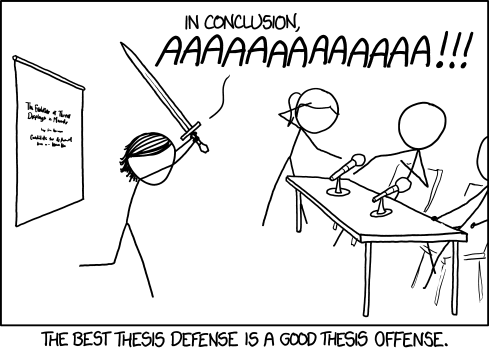
It really is like every other presentation except everything is different: you are the center of attention, you speak longer and your family is in the room. I was in the rush to prepare my slides, and I received a strong preparation from my supervisors and colleagues. I jokely said that my defense was my best rehearsal, and I think it’s true: I had to present my work several times before the defense, and each time I got better. I think I had 80% of my said written down, word for word, as a life jacket, to be honest, it helped.
Also The defense is your moment, you can bend the unspoken rules (just a bit, like adding a joke or two, or a personal touch), and make it your own. I think I did that, and I am happy with the result.
Regrets and what I would have done differently#
- Start doing sports earlier
- Not writing this extra paper between the manuscript and the defense, I really stretched myself too thin on this one
- I probably should have tried to take a bit more vacations, and cut the work cleaner at the end of the day (I admire those who leaves their laptop at work.)
- Taking more notes
Would I do it again ?#
Definetly, and probably just the same way. Thank you to everyone who made this possible.